First Time For Everything
I talk about my first time Dungeon Mastering, and various influences on my DMing style and philosophy.
1/8/20266 min read


First Time For Everything
It took a long time for me to say that I’m a decent Dungeon Master. I’d say I’m pretty good at this point. To quote a famous Replicant: I’ve seen things you people wouldn’t believe. I’ve run a multitude of games across a variety of rules systems, genres, and characters, and am working on my second book for publication. But like anyone who’s halfway decent at anything, there was a time when I didn’t know what the hell I was doing.
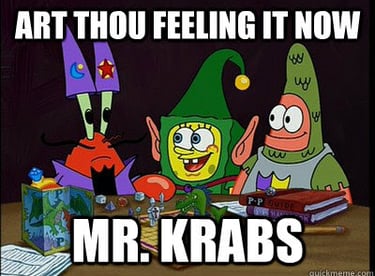
Presumably, like many gamers before the age of Actual Play, I stumbled through my first roleplaying games in high school. Also, like many gamers, I didn’t have any real idea of what I was supposed to be doing. I thought I knew what people did when they played role-playing games: the stereotypical image of a bunch of geeks sitting around in a basement dressed up as wizards and dwarves. You could only speak in faux-Shakespearean dialogue, full of “thees” and “thous”, and behind the mysterious DM screen, the Dungeon Master ruled his world like a tyrant, showering gold upon those who had earned his favor, and dealing death to those who did not.
SpongeBob may have informed this mental image.
Over time, I learned that only part of that is true. But reading a role-playing game book for the first time unlocked something within me that remains to this day. In many ways, RPGs are more than a hobby for me; playing them has introduced me to new friends, opened up opportunities, and created an environment where I can let my imagination run wild while telling epic stories. But let’s go back a bit.
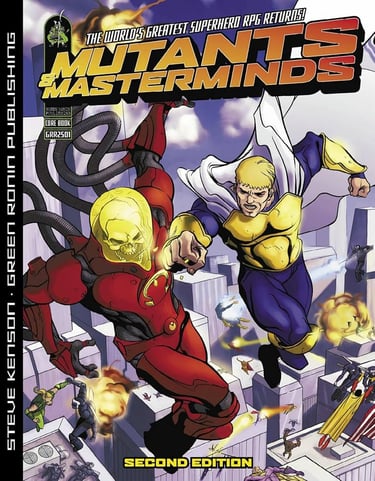
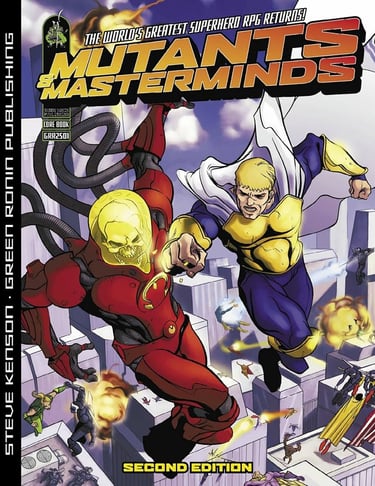
I found my first role-playing game, the second edition of Mutants & Masterminds, at Barnes & Noble. Having heard very little about Dungeons & Dragons itself, other than the faintest echoes of the “Satanic Panic”, that roleplaying games summoned the devil or whatever, I really didn’t know what I was doing. But something about the action-packed cover appealed to me on a deep level. I collected comic books back then (still do to a certain extent, but now I collect trades rather than single issues), so the idea of being able to play out a superheroic adventure with characters my friends made themselves was immensely exciting. So I bought the book soon after and cracked it open.
To be fair, it's still a really cool cover.
On some level, I must have been disappointed to see there was a lot of math. Board games are one thing; you have a small booklet in the box that shows you the rules, and it’s maybe a few pages long, but with a role-playing game, the book, which can be hundreds of pages long, is almost all rules. That was very daunting as someone who had never played a role-playing game before, but I persevered.
Sort of.
After spending some time with the rules and puzzling over them, I ended up playing on instant messenger (AOL Instant Messenger, which dates me quite a bit) and on a few online forums before I took the plunge and DMed some friends from high school. I was very nervous my first time DMing, and…it was just okay. I mean, it wasn’t anything extraordinary, and I looked at the book a lot, but it was alright! But I could do better, and in time, I would learn.
Looking back on it now, the reason my early games were lackluster was twofold (other than the fact that I was like, fifteen): I needed to learn the rules well enough to be able to improvise based on the situation, and I needed to make my story flexible enough to be able to present the story without the players feeling shoehorned into whichever plot I wrote. Having carefully crafted a scenario (complete with scripted dialogue!), when anything popped up that wasn’t in my story, I froze up. Actually, now that I think about it, there was only a brief, freeform roleplay followed by a supervillain fight. I may have even said, “Okay, now roleplay with your team.” But learning why characters roleplay with each other, that would come much later. For that time, I was okay with making up superhero characters and having them slug it out.
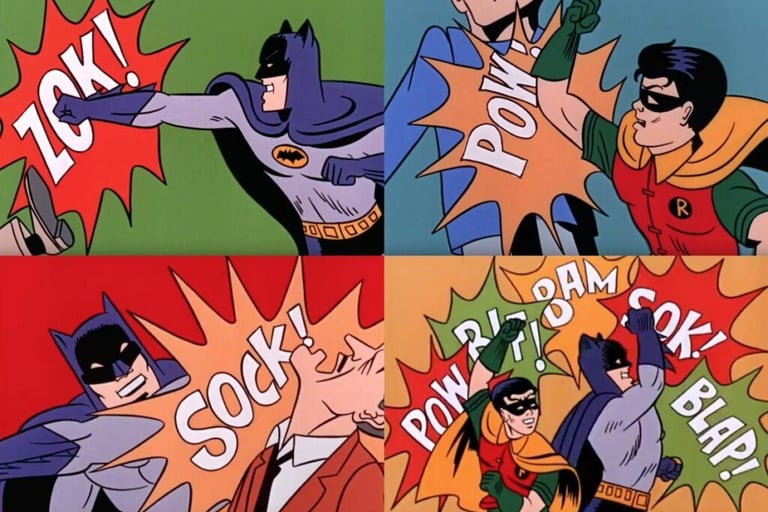
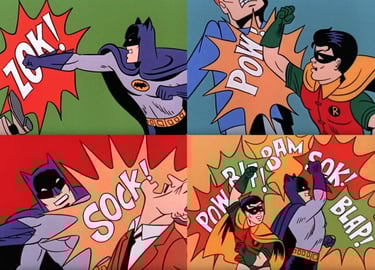
Holy cheesy sound effects, Batman!
I played throughout high school and on and off in college, and for a time, I didn’t play much at all. But eventually, role-playing games found their way back into my life and inspired me to DM once again. Through my friendship with Matt Finch, I played in several games of his OSR game, Swords & Wizardry. OSR stands for Old-School Renaissance, and games designed in this movement draw inspiration from older editions of Dungeons & Dragons and emphasize rulings from the Dungeon Master, player skill over character abilities, grounded play, and the idea of eschewing game balance.
To this last point, rather than making a perfectly balanced encounter (whatever that means) for the character’s level, ie, level 1 opponents fighting a band of goblins while level 20 characters face dragons and liches, players may (and will) come across threats they’re not powerful enough to face. In these situations, players will need to either devise a clever plan or run away. Having played numerous horror games since then, such as Deadlands, Mothership, or Call of Cthulhu, those games don’t include a challenge rating showing how powerful a creature is compared to the heroes. The idea of having your heroes face off against something that may actually be too powerful means they will have to resort to other tactics to win the day.
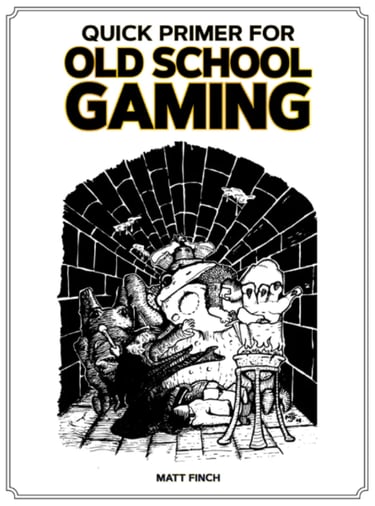
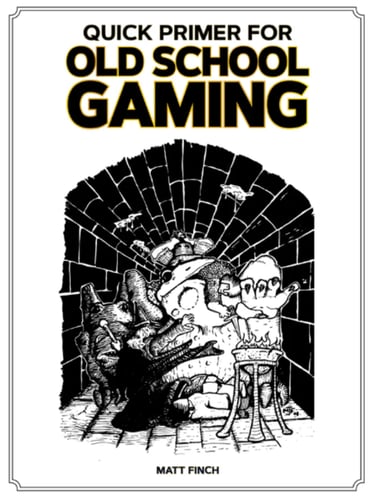
I highly recommend that every current or aspiring Dungeon Master read the Quick Primer for Old-School Gaming. It is simply chock-full of excellent advice, no matter which system you play.
One of the things I found most interesting is that you have to be very specific about how you describe what you’re doing. Rather than rolling a dice to detect a trap or secret treasure chest, you need to state out loud where you search, how you’re looking at something, and what you’re doing to interact with it (see “The Mysterious Moose Head” on pg. 8 of the Primer). This concept was eye-opening: instead of the binary outcome of passing or failing a roll, players describing what they do to attempt an action just made sense.
Although I run games with a more modern ruleset most of the time, where the rules cover most actions, the lessons learned from OSR gaming remain a big part of my DMing style. I prefer characters to describe their actions, doing things like roleplaying how they convince the guards to let them in. I often offer bonuses for describing things that make sense to do or would add to the story. It’s one thing to roll a Stealth check to sneak past the dragon simply, and quite another to say your rogue carefully steps around the dragon’s hoard to not disturb the piles of gold.
You certainly could just roll the dice and see what happens, but what’s the fun in that? You might as well play a video game, which, not that there’s anything wrong with that, but in role-playing games, you’re telling a story. Why not add some detail for how your character would do it? It not only helps players get their time to shine, but also brings everyone into the game more. When your barbarian gets that much-needed critical hit that kills the dragon just as the party is starting to lose hope of survival, describe it. Have those big cinematic moments!
In my philosophy of DMing, every player character is the main character of a story. You’re good at what you do. Your successes should be epic moments in the story that let you show your stuff. Failures are inevitable, but they shouldn’t be from your character being incompetent. Instead, treat them as ways to keep the story’s momentum going. Sure, your rogue may have failed that Stealth roll and alerted the guards, but now you’re in an exciting chase scene where your rogue might just slip away, if they’re lucky!
So, from humble origins stumbling onto role-playing games in the back of a Barnes & Noble, to running my own gaming convention and starting a company, I say this: you never know what you’re missing until you try. Until next time!
- Tanner
Link to Matt Finch's Quick Primer for Old School Gaming: : https://www.mythmeregames.com/products/quick-primer-for-old-school-gaming-pdf-free?srsltid=AfmBOoqeVsbMdxahks0TFenIKt9mGz53e8kbHyeXuhlJvC2X1i3yOQN9