Learning How to Teach
I discuss my background as a teacher and talk about teaching new players how to play role-playing games.
1/25/20269 min read


As I have mentioned before, I started gaming not really knowing what I was doing. I was only vaguely familiar with role-playing games in general. Over time, I learned not only how to play but also how to teach others to play, and to share a bit of what I feel every time I sit down to play.
I don’t mention this often, but I do have a background in teaching. Before I started my Master’s in Library Science, I earned a Bachelor’s degree in Elementary Education. Thankfully, I decided to go a different route; although I love teaching and working with students, this was a few scant years before COVID turned the teaching profession upside down. What I meant by all this is that I’m in a unique position to explain how using teaching techniques can help your new players feel confident in their game.
Role-playing games are complicated, especially if you’re just starting. Most role-playing rulebooks are about the size of college textbooks. With Dungeons & Dragons in particular, if you want to DM a game, you need a Player’s Handbook, a Monster Manual, and a Dungeon Master’s Guide, to say nothing of adventures, miniatures, maps, and all the fun little accoutrements that DMs bring to the table. Not only is learning one a significant time investment, but it can also be expensive. If a new player is coming to a role-playing game having only played board games before, all of that can be very intimidating, so it’s essential to not only give them a good first impression with gaming but also to help them understand the rules and start playing as quickly as possible.
For this article, I will use Dungeons & Dragons as my example. The article also assumes that your new players have little to no exposure to D&D beyond seeing it played on Stranger Things or an actual-play show like Critical Role. I won’t go through each step, but I'll provide an overall guideline to help your players use what they already know to understand and jump into the game quickly. Of course, if they already know some of this stuff, feel free to skip any unnecessary steps. I will also provide a brief script I use when explaining things to new players; feel free to use it at your discretion.
Also, please note that this won’t be an in-depth dive into building a character sheet; there are plenty of those articles out there, but this is more about sharing my method for introducing the game to brand-new players and, hopefully, inspiring a new way to think about it.
Start With the Familiar
The first step is to skip in-game vocabulary for the moment. A new player doesn’t know what AC, hit points, saving throws, proficiency bonus, or THAC0 are (if you’re kickin’ it old school), so forget about that for now. Instead, start with this: what does your player know about fantasy or the genre you’re playing in? For D&D, I typically start with: "Have you watched or read Lord of the Rings?" If they say no, maybe they’ve seen Conan the Barbarian. Perhaps Neverending Story? The Princess Bride? The new Dungeons & Dragons movie?
The old Dungeons & Dragons movie?
Having some media that your player(s) are familiar with in the genre you’re playing is a good jumping-off point for understanding the game. They may be vaguely familiar with D&D, but knowing that its setting is typically a medieval fantasy world with elves, dwarves, dragons, and other fantasy creatures is a good start to being on the same page as the group.
If you’re running a game set in an established universe or intellectual property, such as Star Wars: Edge of the Empire, Alien: The Roleplaying Game, or any of the numerous role-playing games based on movie properties from Evil Genius games, the above advice is applicable too.
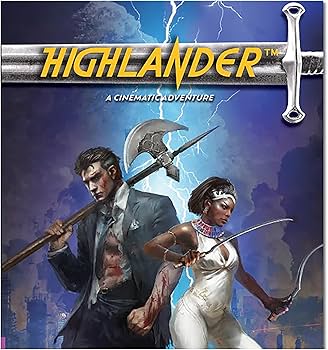
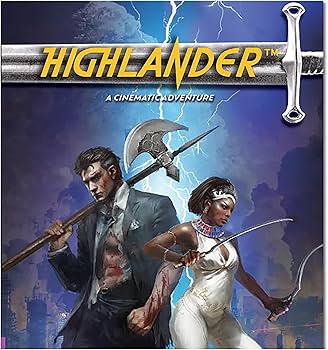
There can be only one! Seriously, I want to try the Highlander role-playing game ASAP.
When playing games with IPs, I recommend gauging how much your players know about said IP before the game starts. Using Star Wars as an example, the knowledge gap for IPs can be vast: have your players seen the Star Wars movies in the first place, or can they name every member of the Max Rebo band in the extended cut of Return of the Jedi? Do they know every member of Chewbacca’s family from the Star Wars Christmas Special? Sorry to bring that particular bit of trivia up, but to my point: players who don’t know much about a specific IP may need more context than those who do.
Weird Dice and You
Eventually, the question will come up: what’s up with all the weird dice? A good place to start with D&D is the iconic twenty-sided dice, or d20. Even that term is jargon-y: it helps to explain that the “d” prefix is a common way to say “dice type”, followed by the number of sides it has.
Here’s how I would explain that: “You use the twenty-sided dice, or d20, to determine success when outcomes are uncertain, including attack rolls, skill checks, saving throws to avoid hazards, and initiative to determine turn order in combat. Sometimes, you will be able to take Advantage on rolls if you’re in a better situation to succeed, and you roll two twenty-sided dice and take the higher of the two rolls. You may also have situations where you must take Disadvantage, which uses the lower of two rolls.”
Pick a Class and Species
Next, ask them what kind of character they want to play, and make suggestions from there. Are they interested in using swords and shields in combat, or spells? If they use magic, do they draw their powers from divine miracles or from their connection to nature? Now, time to start gradually bringing in game vocabulary: classes as a broad way to describe what your character does for the party (front-line fighter, magic spells, healing, buffing/debuffing) and talk about the specific classes based on what the player is interested in trying out.
For example, if they’re primarily interested in using spells, of course, you can suggest the Sorcerer, Warlock, or Wizard class. This comes back to not assuming your players know the difference, because, to the uninitiated, these three terms mean basically the same thing. You will need to explain the difference, for example:
Sorcerers in D&D have a magical birthright or a bloodline that gives them their powers. They start with a smaller selection of spells, but can modify those spells on the fly using their metamagic ability.
Warlocks get their abilities from a pact made with a powerful magical patron, such as a demon, a genie, or a celestial being. Your patron will eventually grant you a gift called a Pact that grants you extra abilities
Wizards are powerful magic-users who typically spend years studying the arcane arts. Wizards usually specialize in one kind of magic, called an Arcane Tradition, but have a wide variety of spells they can cast.
I would say that at this point, most people are familiar with elves and dwarves, things like that. Hopefully, you don’t need to explain that. But as needed, you can describe the typical fantasy species of D&D, including those that are less common in popular culture, such as dragonborn or tieflings. Again, for brevity, I will not go into detail about each one, but use your best judgment and your player’s existing knowledge of fantasy tropes and expand upon the ones they don’t know as much about.
Ability Scores and Skills
After choosing a class and race, now you can get into the nitty-gritty stuff. Figuring out ability scores is generally my second step after picking class and species, because it helps your player visualize their character better.
I generally explain ability scores like this: Ability scores are a measure of your character’s aptitudes, such as their strength, their health, and their intelligence. The higher the number, the better they are at it. A 10 in an ability score is about average, but it’s okay if some of yours are lower than 10. Some classes will likely benefit from having a higher number in specific abilities, for example: Fighters and Barbarians benefit from a higher Strength, and Wizards should have a higher Intelligence.
To use the typical human Fighter as an example, a Fighter with a higher Strength and Dexterity, but a below-average Charisma, is powerful and fit, but is less talented when dealing with people, or is rough around the edges. An elven Bard with a higher Charisma but lower Strength and Constitution is likely much smaller but more talented in their people skills.
To explain modifiers, I suggest using the above example: the higher an ability score is, the better a character is at tasks that use that ability. Let’s say our human Fighter has a Strength of 16 and a Dexterity of 12. At this point, your players should understand that the Fighter has a high Strength and an above-average Dexterity. Taking that information, then you can explain that a modifier gives you a bonus to your d20 when performing tasks that use that ability, and every 2 you go over the average of 10 gives you a +1. So your human Fighter has a 16 in Strength, which gives him +3 to any rolls using his Strength, including Athletics skill checks, Strength saving throws, and rolls to hit with melee weapons. His 12 Dexterity gives him +1 when rolling for Stealth, Dexterity saving throws, and rolls to hit with ranged weapons, among many other things.
Similarly, although players will know what skills are, the connection between them and the corresponding ability score might not be. Explaining that ability scores directly helps a lot; the higher the number you have in an attribute, the higher your modifier is, and the easier it is to succeed with skills that use it. To go back to my main point, use D&D’s rules and esoteric vocabulary as tools to further understanding, not as barriers to entry.
Hit Points and Initiative
With the proliferation of role-playing game elements in video games, explaining hit points might not be too difficult, but still, don’t make assumptions about what your players know. Contextualizing hit points by saying that it’s a sort of “health bar” for your character is a great way to start. The more damage you take, and every time you take damage, your hit points go down by the amount of damage you take. If your Hit Points ever reach 0 or lower, you must roll a d20 up to three times to see if your character survives. Now that you’ve explained what d20 stands for, you can use it in the context of the game!
D&D, like many other games, uses a turn order. Initiative is determined by rolling a d20 and adding your Dexterity modifier. The more dexterous you are, the more likely you are to take the first turn in combat. After everyone has rolled initiative, the Dungeon Master writes down the initiative rolls in numerical order, and
Final Point: Just Be Patient
I feel like I’ve explained my point thoroughly without needing to discuss every part of a D&D character sheet. Giving context to jargon and in-game terminology helps new players better understand and builds their confidence, helping them not be afraid to make mistakes.
One point I forgot to mention in my Dungeon Master etiquette guide: don’t expect new players to know how to play immediately. Although that should be common sense, unfortunately, it happens. I often hear about new players having a bad experience when sitting down at a table, and everyone expects them to know the rules and starts spouting in-game vocabulary and jargon at them. Not only does this create an impossibly high entry bar, discouraging them from trying the game again if the group starts using terminology they aren’t familiar with or assumes they already know. It’s not only rude, but it also makes the new players feel stupid for not understanding a complicated game right off the bat. People learn at different rates, and everyone has their own methods of understanding new information. Just be patient with new players: they’ll get the hang of it in their own time.
If someone has a bad experience in their first game or feels stupid for something they don’t know, they will almost certainly never play again. No one likes gatekeeping, so just don’t do it. We’re all just here to have a good time and slay some non-metaphorical dragons.
On an unrelated note, I’ll have an official company logo in about a week! Progress continues on my sci-fi/horror manuscript; the editing process is ongoing, but it’ll be well worth the wait. Although I will have a launch page ready once I get more artwork for the book, I will not start the Kickstarter itself until the book is ready
- Tanner
Links to Games Mentioned: